Chapter 8
Axess Sexual Health Service
Innovating Sexual Health Services for an Inclusive Future.

Understanding the challenge
Why is sexual health important?
Good sexual health is important because it is a key part of overall well‑being. It includes a person’s physical, emotional, mental, and social health. It is important that we help people enjoy a healthy and positive sex life.
What impact do poor outcomes have on the city?
When sexually transmitted infections (STIs) and HIV are not treated, and when people cannot easily get contraception or support, it creates a serious public health problem. Untreated STIs can cause infertility and long‑term health issues. When HIV is diagnosed late, health outcomes are worse. When people have fewer contraceptive choices and prevention options, unplanned and teenage pregnancies often increase.
What did our review of previous services find?
The need for sexual health services is high. Services were struggling to meet everyone’s needs. There was strong demand for testing and contraception, but many chances were missed to support people with STIs, HIV, contraception, and education in a single visit. Digital changes were needed to allow remote access and online testing. There was also a need for a better website to help residents find services more easily.
What does “good” look like in this area?
Guidance from the Association of Directors of Public Health and the Department of Health and Social Care says that services should be easy to access and well promoted to communities. Services must also be friendly for young people and offer joined‑up appointments. These appointments should allow screening, contraception, and prevention measures. For example, condom access and STI and HIV test to happen at the same time.
Drivers behind the new approach
Post transformation:
Liverpool City Council Public Health and Axess won the Gold Award in 2022 in the “Transformation in Health and Social Care Category” at the iESE Public Sector Awards.
The theme was Demonstrating greatest impact for residents in health or social care service.
After a review in 2020–21, the goal was to make services easier for Liverpool residents to access. This included offering more service locations across the city and giving more care in each appointment so people would not need several visits for different types of support.
Axess Sexual Health was created to give residents simple access to STI testing, treatment, and contraception in one visit. This reduces repeat appointments and helps people get everything they need at once. Liverpool University Hospitals Group (LUHG) runs the service for the council and worked with the Public Health team to open three new hub clinics. The service also increased the number of pharmacies offering advice, testing, treatment, and contraception. A 24/7 digital service lets people order online testing kits and have them delivered to their homes or to collection points. There are
now more than 80 places across the city where residents can access support, so help is always close by.
The transformation also increased the focus on prevention. An education team now trains staff and frontline workers, including teachers, to have positive conversations about sexual health. They also deliver sessions to community groups about sexual health and service locations.
Axess works with community and voluntary groups through outreach services and a mobile bus to reach people who need support. Key groups supported include:
- Young people
- LGBTQ+ communities (including a clinic for trans and non‑binary people)
- People who are homeless or use drugs
- Migrants and ethnic minority groups
- People with disabilities
The impact of the transformation of sexual health services for an inclusive future
Increased appointment availability and meeting need with
Over 15,000 additional attendees since 2019-20.
21% reduction in new STIs in 2024 data.
Significant increase in screening and testing 9,052 more tests per year.
Improved access to contraception including long-acting reversible methods.
Flexible outreach / mobile bus offering more support to under-served groups – taking
services to communities with18,655 interventions and tests.
A city of ‘firsts’
The partnership between Public Health Liverpool and Axess Sexual Health (LUHG) has created new and innovative ways to improve health outcomes and access for residents. These include:
UK’s first pharmacy implant service (long‑acting reversible contraception)
In September 2025, Axess Sexual Health launched a pilot that allows people to get LARC through a pharmacy. Early data shows it is very popular, and more pharmacies are expected to join the scheme.
New approaches to reduce STIs
Liverpool was the first area in the country to offer “doxyPEP.” This allows people at higher risk to take doxycycline (an antibiotic) after sex to lower their risk of syphilis and chlamydia.
PrEPDirect launched in November 2025
This online service sends HIV‑prevention medication (PrEP) directly to patients. They no longer need to visit a clinic to receive it.
PrEP delivery through pharmacies
Axess is also now ready to launch the UK’s first PrEP service in a pharmacy.
Holistic women’s health hubs
A network of women’s health hubs has been set up across the city, with support, training and oversight provided by Axess. The hubs allow women to access contraception, STI/HIV testing, cervical screening, menopause care and support around menstrual health. There is now also a HIV PrEP offer in the hubs to provide women with access to this. This has resulted in a dramatic improvement in the uptake of LARC across the city. The hubs were shortlisted for the Excellence in Primary Care and Community Care category at the NHS Parliamentary Awards 2024.
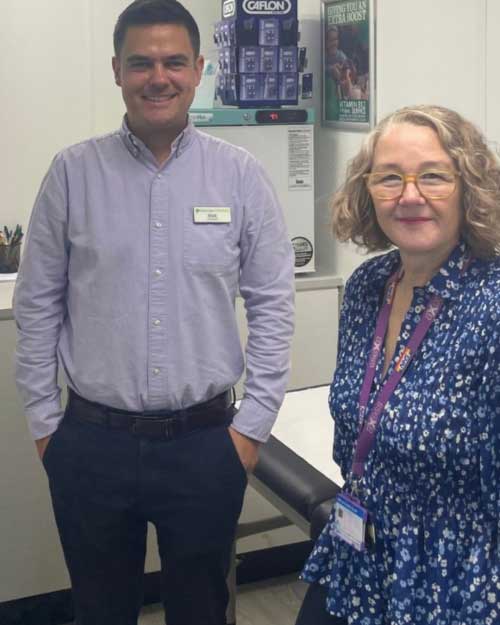
Pharmacist Matt Harvey and Sian Davies from Axess Sexual Health.
Case study
Experience before the integrated service / transformation
A young person in Liverpool previously needed to visit up to three different sexual health providers to receive the care they needed. Basic testing and oral contraception were provided in the young persons’ offer, with more complex STI testing, treatment and complex contraception provided at different sites, with no shared records. This meant that STI treatment could be delayed leading to onward spread of infection. No digital service existed to support faster, easier access.
Experience after the integrated service / transformation
Chloe (not her real name) recently attended the Axess dedicated young persons clinic ‘Axess 4 U’. She is a 19-year-old university student who has reported a recent new partner. She has no current symptoms, but she wants reassurance and contraception advice. The service offers same‑day testing, treatment, and contraception support.
Despite having no symptoms Chloe’s results show she does have an STI, but with the highly skilled and professional team at Axess (and the help of rapid results) she is supported and treated promptly, and has other needs discussed as part of her consultation, including ongoing contraception, and access to condoms and advice.
Why is this case study so important?
- Young people need access to good, reliable and clear information around their sexual health, promptly
- Young people are at higher risk of STIs, with many not showing any symptoms, so rapid access to screening, and treatment is important.
- The nurse lead was able to discuss other issues with Chloe in a non-judgemental way, supporting her to make informed decisions around contraception and ongoing testing as part of good sexual healthcare
From now to next
There are ongoing plans and development areas to improve the service and the sexual health and wellbeing of our population, which include:
- Working with partners across the city to develop strengthened plans to improve young persons’ sexual health and wellbeing.
- Improved, more targeted school-based education and relationships offer.
- More pharmacy services for testing and contraception (including implants)
- Better access to HIV prevention for women
- Improved partner notification (telling partners about STIs)
- Holistic support for women and girls attending abortion services