Chapter 3
Data and Intelligence
An overview of the city’s current health picture.

Life expectancy in Liverpool by Mersey Rail train stations
This map of the Merseyrail network shows how in just a short train ride across the city, the average length of time a person lives decreases.
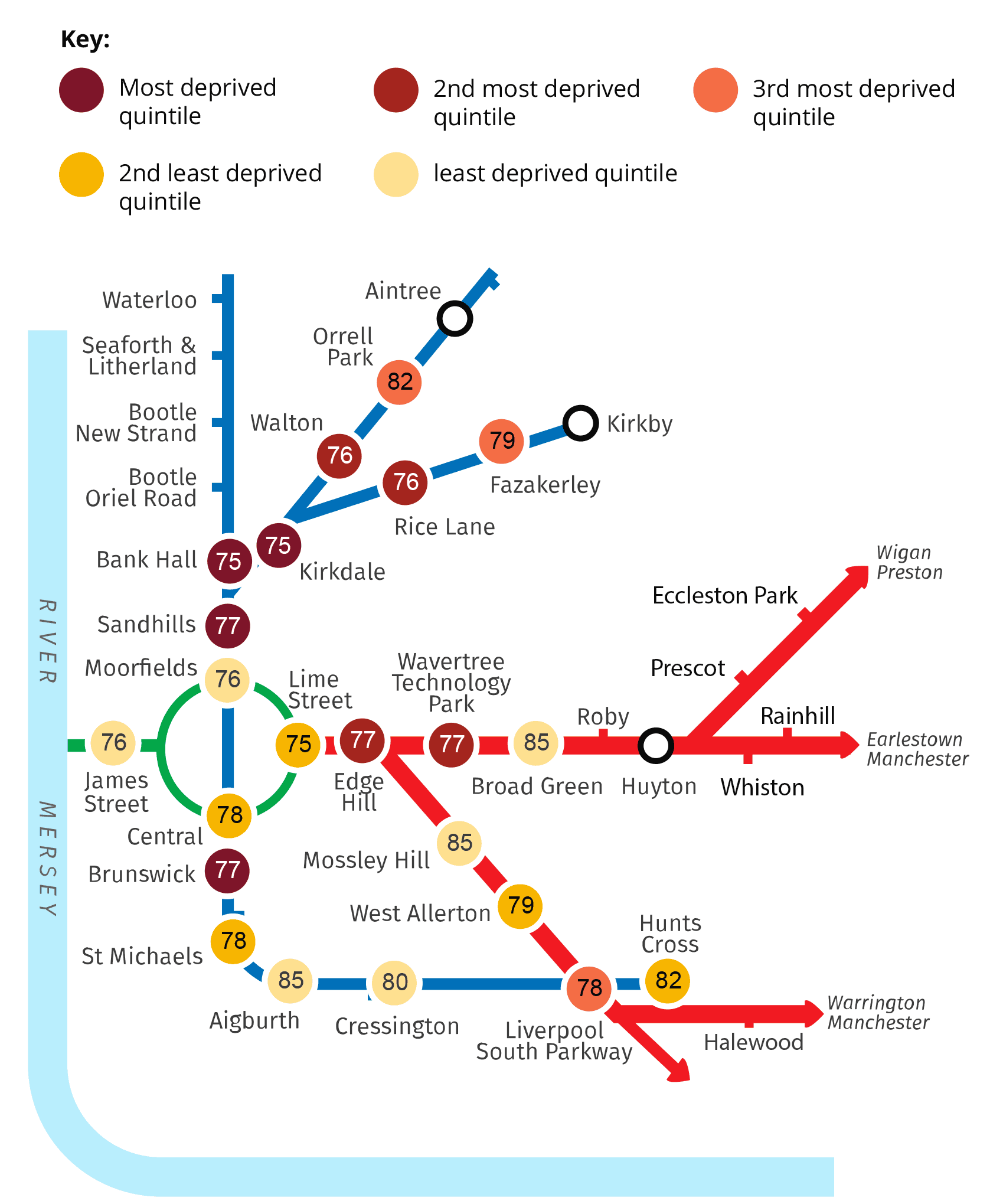
Created by modifying “A map of the Merseyrail network in Liverpool.” (Copyright David Arthur (Licensed under CC by 4.0))
Infographic summary
The infographic shows Liverpool wards from 2020-2026 in train stops. It demonstrates how in just a short train ride, the average length of time a person lives decreases by 10 years.
- A coloured square over each train stop represents the wards quintile of deprivation.
- The number inside each coloured square represents life expectancy in that ward.
Dark red circle – most deprived quintile
- Bank Hall – life expectancy = 75
- Kirkdale – life expectancy = 75
- Sand Hills – life expectancy = 77
- Brunswick – life expectancy = 77
Red circle – second most deprived quintile
Walton – life expectancy = 76
Rice Lane – life expectancy= 76
Edge Hill – life expectancy = 77
Wavertree Technology Park – life expectancy = 77
Orange circle – third most deprived quintile
Orrell Park – life expectancy = 82
Fazakerley – life expectancy = 79
Liverpool South Parkway – life expectancy = 78
Yellow circle – second least deprived quintile
Lime Street – life expectancy = 75
Central – life expectancy = 78
St Michaels – life expectancy = 78
Hunts Cross – life expectancy = 82
West Allerton – life expectancy = 79
Cream circle – least deprived quintile
Moorfields – life expectancy = 76
Broadgreen – life expectancy = 85
James Street – life expectancy = 76
Mossley Hill – life expectancy = 85
Cressington – life expectancy = 80
Aigburth – life expectancy = 85
Ages 0-19 years

43% of 10-11 year-olds are overweight or obese.

72%of babies now have breastmilk as their first feed.
Sexual health

High rates of sexually transmitted infections.

21%reduction in new STIs.

36%is the current rate of HIV late diagnosis, which has fallen from previous levels.
Healthy weight

3 in 10 adults are obese.
23%is the current rate of physical inactivity, which has fallen from previous levels.
Addictions
Too many people are dying from drugs and alcohol.
Successful completions for individuals in treatment is increasing.
Tobacco

12% of adults smoke.
66% of quit attempts using stop‑smoking services. This figure has risen.
Infection control

The UK has seen a reestablishment and rise in infections.
Control measures and rapid response are reducing the impact in the community and on healthcare.