Chapter 4
Mersey Care 0-19 Service
Transforming support for children, young people and families.
Understanding the challenge
People in Liverpool have big differences in health and face many problems. Poverty can cause bad effects on health, learning, and life in the future. In Liverpool, about 24,000 children live in poverty. That is almost one out of every three children. The State of Health in the City: Liverpool 2040 launched in 2024 said that if nothing changes, the health and wellbeing of local children and young people will get worse.
On March 1, 2023, the Council agreed to change services for children and young people from birth to 19 years old (or up to 25 years for those who need extra help). These services include Health Visitors, the Family Nurse Partnership, and School Nurses. They work to make sure children in Liverpool have the best start in life.
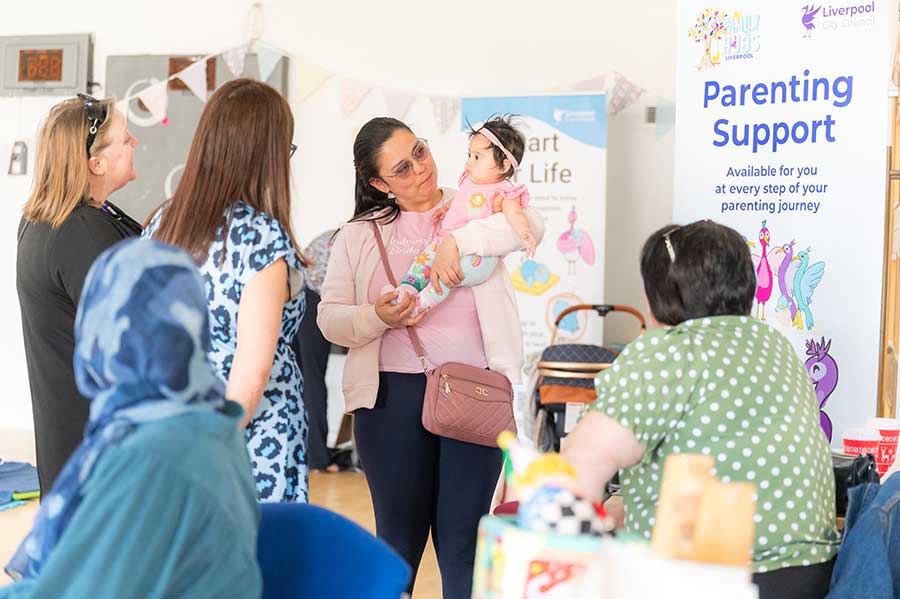
A woman holding a baby at a parenting support event at a family hub centre surrounded by adults.
Drivers behind the new approach
The plan showed the need to look at, change, and improve 0 to 19/25 services. The service helps to use resources better and work with partners. Local services will stop problems early, work together and prevent issues from getting worse.
In November 2024, Mersey Care NHS Foundation Trust, working with Alder Hey NHS Foundation Trust, won the contract. They promised to join health services to give better results, smooth care, and better teamwork.
Starting on 1 April 2025, the new service will work in an integrated way. Teams will be base in local areas and, where possible, share space in Family Hubs.
The service will give extra help to vulnerable children, young people, and families. This includes extra visits at 3 months, 6 months, and 4 years. As well as new specialist roles like Infant Feeding, Perinatal Mental Health, Research, and Safeguarding. Schools will get a clear offer, and there will be more face-to-face meetings again.
There will be better support for Children in Care, those with care experience, and other vulnerable groups. Mental and emotional health will be a big focus at all levels of care.
Case study
“A single mother, pregnant for the first time at age 40 decided to return to Liverpool to be near to extended family. The baby was born and diagnosed with Down Syndrome and further medical complications. The Health Visitor developed a close liaison with Alder Hey Hospital when the baby was admitted for open heart surgery, and the family was identified as requiring additional support and received regular health and development reviews and given encouragement to celebrate what child was able to do rather than focus on his disability.
The Health Visitor has provided regular and consistent support and signposted to many other agencies e.g. PADS (positive about Down Syndrome), Singing Hands, Community Physiotherapy, Occupational therapy, Speech and Language therapy, and the Children’s centre.
The Health Visitor has been a link between mum, child and all other agencies involved and has been proactive in obtaining support and follow ups for the child, including a referral to the Early Notification Team in Liverpool City Council and support and information to access Makaton Training (plus a successful application for funding for mum to complete basic training).
Provided advice and support about benefits and nursery places, the Health Visitor has provided ongoing encouragement and support for mum in her parenting role who was encouraged to share her experiences at a SEND Champions meeting.
The family is thriving and mum reports feeling confident and ‘enabled’ by the support she has received.”
Video transcript
[Intro music playing with video footage fading in and out showing baby’s nursery, the caption ‘Joannah’s story’, a cot mobile, a heavily pregnant woman holding her bump whilst looking in her bedroom mirror, a train moving down the track, Liverpool Lime Street train station entrance and St George’s Hall. (Non-speech audio description)
[00:13] Speaker: Joannah – “I knew that becoming a single mum at 40 was going to be a challenge so I returned to Liverpool to be closer to my family.” (Spoken Dialogue)
[Video footage of Joannah at hospital with her baby in an incubator.] (Non-speech audio description)
[00:22] Speaker: “But when David arrived with Down syndrome and heart complications, I was really anxious.” (Spoken Dialogue)
[Video footage fading in and out showing a Health visitor, visiting Joannah at home, Joannah walking behind David in a hospital corridor whilst he is being wheeled to theatre, Joannah accepting a hot drink from her health visitor and then seated alongside her health visitor in a hospital waiting area.] (Non-speech audio description)
[00:28] Speaker: “My Health Visitor became our absolute rock from her first visit when David was admitted to Alder Hey for open heart surgery. She was a vital link between US and the hospital and provided constant support.” (Spoken Dialogue)
[Video footage fading in and out showing Joannah and her baby at an appointment with a health practioner, David taking first steps, Joannah and David at an appointment with a speech and language therapist and David walking hand in hand with Joannah.] (Non-speech audio description)
[00:41] Speaker: “Through the Health Visitor we were able to access specialist support including physio, speech therapy and the local children’s centre.” (Spoken Dialogue)
[Video footage fading in and out showing David as a toddler climbing step to toliet, a toliet training star chart, .] (Non-speech audio description)
[00:51] Speaker: “The Health Visitor provided individualised care for David, supporting us with with toilet training and much more.” (Spoken Dialogue)
[Video footage fading in and out showing David playing in garden, Joannah drinking tea at home with Health Visitor.] (Non-speech audio description)
[00:58] Speaker: “She didn’t just coordinate his care, she cared for me and changed my whole perspective.” (Spoken Dialogue)
[Video footage fading in and out showing David putting shape into shape sorter and David splashing water whilst bathing.] (Non-speech audio description)
[01:03] Speaker: “She taught me to stop worrying about the disability and celebrate everything he could do.” (Spoken Dialogue)
[Video footage fading in and out showing David running towards playground, and Joannah speaking with another parent at a playgroup.] (Non-speech audio description)
[01:08] Speaker: “We went from feeling isolated to having a whole community around us.” (Spoken Dialogue)
[Video footage fading in and out showing Joannah helping David put on backpack and then walking outside holding hands.] (Non-speech audio description)
[01:12] Speaker: “It hasn’t been easy, but with their consistent support, we’ve come so far.” (Spoken Dialogue)
[Video footage fading in and out showing Joannah smiling looking out window with hot drink in her hand, then Joannah seated at table, talking on the phone with open notebook and laptop in front of her.] (Non-speech audio description)
[01:17] Speaker: “Now I feel empowered to advocate for parents of children with Down syndrome.” (Spoken Dialogue)
[Video footage fading in and out showing David getting his shoes from shoe rack, David running out into garden.] (Non-speech audio description)
[01:22] Speaker: “And when I look at David, I don’t see a diagnosis. I see my little boy’s future.” (Spoken Dialogue)
[Image of Liverpool City Council logo fades in and out] (Non-speech audio description)
[01:33] [ Closing music with credit text fading in and out – Executive Producer Alex Kayer, Production Manager Sam Boorley, Directed and Edited by Michael Bailey, Voice actor Jenny Collins, Original Score Composed by Jacob Handslip.] (Non-speech audio description)
[01:52] [End card: A Generative Minds Production logo. Liverpool City Council logo, Merseycare Foundation logo, and text ‘for Liverpool City Council Public Health Team’ Copyright Generative Minds 2026]
From now to next
Public Health services help children, young people, and families stay healthy. They focus on building strong foundations for wellbeing in the early years. This helps children and young people have the best start in life.
We aim to improve physical health, mental health, and emotional wellbeing. We also work to make health fair for everyone in our communities.
We will work with partners and communities to keep children and young people safe. We will help them make positive changes.